Dear friends of Astounding Knits:
Alas, despite my best intentions, myriad projects are pulling me away from this blog and the land of astounding knitting & crochet. Thanks for all your interest and support over the years! I hope you'll continue to visit me at my website, and at my Pinterest boards.
xxx,
Lela
Friday, July 19, 2013

Tuesday, May 21, 2013
In Consideration of Strange Heirlooms
A few weeks ago, my mother-in-law sent my daughter an heirloom from her family—the small, crocheted piece pictured below that, much to my surprise, she identified as a "pot holder." It got me thinking about heirlooms generally—mine, ours, yours—and what many of us have hidden away, or even stashed within reach, that we overlook on a regular basis. Today on the AK blog, I'm kicking off a series on familial hand-crafted heirlooms, beginning with this:
 It is actually quite a bit finer than it appears in my mediocre photo of it. It was stitched of cotton thread, very neatly and carefully, and is in almost perfect condition. Which initially suggested (as did the choice of white thread itself) that, even if it was intended to be a pot holder, it was very rarely used as one.
After my daughter tried it on a variety of dolls (it fit precisely none), I embarked on a little search to see what I could find out about it. Almost right away, I discovered it again on eBay, in its exact opposite color scheme of green and white:

And THAT suggested that a pattern booklet, featuring these "bloomers,"was published around 1940 or so. It must have been favored by women and girls who had some kind of intense hankering to crochet pot holders in the shape of doll clothes. And I imagine that the pattern book looked something like this:

Or this:
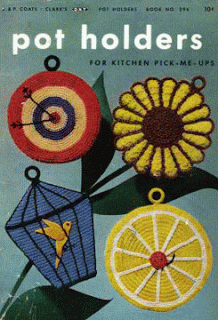
This second pamphlet has a subtitle that reads: "For Kitchen Pick-Me-Ups." So, not just my mother-in-law's ancestor, it seems, but a whole bunch of other people's ancestors, crocheted little figural pot holders—not just in the shape of doll clothes, but also bird cages, animals & insects, fruits, wagon wheels, snowmen—to decorate their kitchens. Which also explains why our "bloomers" are a bit on the thin and not-quite-heat-resistant side. And I'm starting to wonder, now, if somewhere out there exists an enormous stash of these things-I-had-never-before-heard-of, waiting to be unboxed and to brighten a new era of rooms. But I've only found a few online here and there, and none are quite so lovely as the white-and-green bloomers hailing from the McInnis family; or the reverse-color green-and-white ones abandoned to eBay.
There is one more thing I know about these bloomers. Their pattern is spider lace and blocks—spider lace showing up, in my very scant research, in US and UK patterns books from the 1910s onward. It consists of a series of chain-stitch rows that are then stitched to each other, and you can find a tutorial on how to do it here.
Meanwhile, if you know anything about the history of figural pot holders, write in and let me know! Have an heirloom you'd like to share? Write in with that, too. Next up, I'll be plundering the mysterious embroidered pocket full of hand-edged handkerchiefs, from my own side of the family.

After my daughter tried it on a variety of dolls (it fit precisely none), I embarked on a little search to see what I could find out about it. Almost right away, I discovered it again on eBay, in its exact opposite color scheme of green and white:


Or this:

This second pamphlet has a subtitle that reads: "For Kitchen Pick-Me-Ups." So, not just my mother-in-law's ancestor, it seems, but a whole bunch of other people's ancestors, crocheted little figural pot holders—not just in the shape of doll clothes, but also bird cages, animals & insects, fruits, wagon wheels, snowmen—to decorate their kitchens. Which also explains why our "bloomers" are a bit on the thin and not-quite-heat-resistant side. And I'm starting to wonder, now, if somewhere out there exists an enormous stash of these things-I-had-never-before-heard-of, waiting to be unboxed and to brighten a new era of rooms. But I've only found a few online here and there, and none are quite so lovely as the white-and-green bloomers hailing from the McInnis family; or the reverse-color green-and-white ones abandoned to eBay.
There is one more thing I know about these bloomers. Their pattern is spider lace and blocks—spider lace showing up, in my very scant research, in US and UK patterns books from the 1910s onward. It consists of a series of chain-stitch rows that are then stitched to each other, and you can find a tutorial on how to do it here.
Meanwhile, if you know anything about the history of figural pot holders, write in and let me know! Have an heirloom you'd like to share? Write in with that, too. Next up, I'll be plundering the mysterious embroidered pocket full of hand-edged handkerchiefs, from my own side of the family.
Thursday, April 25, 2013
And Now For Someone Completely Different...
...Meredith Woolnough!
 |
| "Large Red Nautilus," Meredith Woolnough |
Textile artist Meredith Woolnough makes embroidered sculptures inspired by the rich land- and sea-life of her native Australia. Her work is currently featured in a two-woman show titled Entwined at the Kerrie Lowe Gallery in Newton, NSW and this morning, Astounding Knits presents 10 questions-and-answers with the artist about her history, her inspiration, and her future.
1. In the past decade or so, knitting and crochet have made a tremendous turn-around—from being
perceived as something "crafty," to art. Is there a similar turn-around happening now with
embroidery?
I love that there has been this
great surge in hand crafts lately. I think more people are seeing the value in
handmade, labour-based production and these shifts in perception are very
positive, in the art world and in our everyday lives. I have been seeing
more and more embroidery in art galleries; artists are taking the basics of
stitch and reinventing it in their work. It's very exciting and
inspirational.
2. Did you begin as a textile artist?
When I started my art degree, I originally wanted to
focus on painting and photography. I have always painted (and still do) and I
was doing some freelance photography work so I thought that was the direction I
was going to take. But once I started studying fine arts I fell in love with
textiles and all the various facets that are included in fibre art. So I
decided to change direction and major in textiles and I spent the next three
years happily sewing, knitting, dyeing, printing, and weaving. When I decided to
do an honours year at the end of my degree, I chose to focus on embroidery, and
more specifically freehand machine embroidery as I felt that it gave me lots of
scope for creative expression and experimentation. I fell in love with the
process during that year and haven't looked back.
 |
| "Ginkgo Circle," (front), Meredith Woolnough |
3. Did you begin as well with wanting
to explore natural forms?
When I
first started working with embroidery, I was really interested in how embroidery
(and craft arts in general) were placed within the broader art world. As a
result of my research, I was greatly influenced by traditional needlecraft
motifs from various cultures and I used these in my work. I would rework these
tiny motifs into large-scale installation-style works that hung from the roof.
I have always been drawn to natural forms and I think they appear in my work even
when I don't mean them to. As my practice has evolved, I am now working almost
exclusively with natural forms, creating my own embroidered specimens. I am
fascinated by the structures found in nature and how these interrelate among
all living things.
4. In addition to your nature-based
work, you also are exploring elements of traditional lacework. What are the
similarities/differences between these?
The pieces that are based in lace
and filigree designs are some of my early work and I don't really visit them
much these days (unless a commission calls for it). In saying that, I feel that
this early work has been a huge influence on my current work in that it taught
me how to balance a design and work with line effectively. Who know's—I may go
back to this style of work eventually; things have a funny way of going full
circle.
 |
| "Spiraled Skeleton" (two views), Meredith Woolnough |
5. What traditional lacework are you studying and what about it fascinates you?
When I
was studying lacework designs, I was inspired by many types of traditional
embroidery but in particular, I was drawn to European blackwork embroidery. This
is clearly reflected in my dominant use of black in my filigree designs. I am
interested in the intricacies of line and pattern found in embroidery, and how
these designs are repeated. My practice is grounded in repetition—as are many
craft-based techniques. Repetition appears in nature constantly so it seems
fitting that I should try to replicate nature in such a labour- intensive,
repetitious process.
6. Are there things you can only accomplish
using a sewing machine to stitch your work? And conversely, are there things you would try to accomplish only
with hand embroidery?
While I use a sewing machine to create my
work, I still maintain complete control over the machine; it is not automated in
any way. I use the sewing machine like a drawing tool and I see it as just
that—a tool to assist me in creating my art. Sometimes people seem a
little disappointed when they hear that my work is done on a machine. I think they
have these romantic visions of me stitching away at all hours of the night to
create my work and they feel like I have cheated somehow my speeding up the
process through mechanisation. However, if I was to try to create these works by
hand, I think the work would be really limited and suffer as a result. I
physically would not be able to produce the number of works that I do or on the
scale that I would like. There are still hours and hours of work involved in
each of my pieces, and I have certainty fine-tuned my unique approach to
embroidery.
When I teach my embroidery technique, many of the students in my
workshops find the process impossible to begin because of the fine motor
control needed to sew in this way. However, like anything, with time and practice
you can master it. I guess I don't see my work as embroidery in a pure
sense—I see it as the most effective medium to create my artwork. I like to
think that I am pushing embroidery into new areas.
I really enjoy hand
embroidery and find it much more pleasurable than the work I do on the machine.
When I work on the machine it's loud and rather intense work. I hand embroider
myself when I have the time. I love to hand embroider onto thick paper and draw
with the stitches that way.
7. What makes your work art rather than
craft, and how do you think one makes this determination—or should we at all?
I think what sets my work in the world of "art" rather than "craft" is that
I have always seen it as art. I am working with a conscious intention to create
these objects as artworks and it just so happens that I have found that the
best medium to express what I want is a "craft- based" process. I see my work as
sculpture—I am creating forms of my own design to explore concepts that are
important to me as an artist and the medium and process that I use are irrelevant to that. However, in saying that, I think that craft-based media and
techniques are very powerful things to work with when making art because of the
ingrained history associated with them.
 |
| "Big Red Coral Branch," (detail), Meredith Woolnough |
8. Besides embroidery, are there any
other traditional handcrafts that you have in your arsenal? Or are interested
in learning?
Oh yes, so many. I learnt so many wonderful techniques when I was
studying art—and I am always trying to attend workshops to learn new
processes. I particularly love techniques where you start with a basic material
that you can transform into new forms. For that reason, I love to play with
felting, basketry, and weaving. But I am always hungry for more—I don't think
you can ever learn enough so I value learning new skills very highly. I have
always wanted to learn to knit. While I can whip out your basic scarf (albeit a
very uneven one with many dropped stitches), I just can't seem to get my hands
into that smooth knitting rhythm that I see others do. I love watching my mother-in-law knit—it's hypnotic; she doesn't even look down from the TV and a baby
bootie will just appear out of nowhere. It's magic. I think I'll leave knitting
to the experts and stick to me sewing machine for now.
9. I love that you have
taken something that is usually 2-D and figured out how to make it 3-D and
sculptural. How did you hit upon this technique?
The 3-D element is
hugely important to my work and I go to great lengths to maintain the
sculptural quality in my pieces. When I first started working with this
technique, I was producing hanging sculptures or pieces that were pinned
directly to the wall. I loved the shadows that the pieces were casting—they added a whole new quality to the work—so I have been working to hold onto this
quality ever since. It took me months to come up with a technique that
would present my work so that it appeared to "float" off the paper that I mount
it onto. I experimented with perspex rods, hanging strings, and wire but
eventually I came up with just a simple method of pinning the work in place and
spacing it out with long beads. This process allows me to have multi-layered
pieces so I can really capture the 3-D quality of the work without compromising
my designs. Recently, I have been moving back to more sculptural works—I have
a range of pieces that are embedded in resin to form free-standing sculptures.
Also, I have recently started to create hanging sculptures again for an
exhibition I have coming up later this year. It's really nice to work without
the confines of a frame.
10. Have you thought of working
larger, and how that might be accomplished?
I am constantly trying to push my work in scale
and would love to work really big—I just haven't had a project that calls for
it yet. There isn't really a size limitation when working in this technique—it's only how much time and energy you want to commit to a piece. If I was to
work in a really large scale, I would look at doing a work in several pieces
then sewing them together like a big jigsaw puzzle. At present since most of my
work is framed for sale I am limited by the restrictions of the frame (maximum
paper size and weight restrictions etc).

To learn more about the work of Meredith Woolnough, visit her at her website.
Friday, April 19, 2013
Drum roll, please...
Well, finally I've got something ASTOUNDING in the works! Hint: it's not about Ben Cuevas, Frida Kahlo, or Adrienne Sloane. In fact, it's not about a knitter at all! Stay tuned; all will be revealed next week.
Wednesday, March 20, 2013
Time to Pick a Knitter!
We've had three nominations for a knitting artist to be featured in an upcoming post here. What I need from you all now is your VOTE. Who's it going to be?
1. Adrienne Sloane,
2. FridaKahlo, or
3. Ben Cuevas
Write in by leaving a comment at the bottom of this page, letting me know which artist you'd like to know more about. And if you're feeling inspired and ambitious, let me know why. Let the voting begin!
1. Adrienne Sloane,
2. FridaKahlo, or
3. Ben Cuevas
Write in by leaving a comment at the bottom of this page, letting me know which artist you'd like to know more about. And if you're feeling inspired and ambitious, let me know why. Let the voting begin!
Thursday, February 21, 2013
Pick-A-Knitter
Dear Friends:
Is there a spectacular knitting and/or crocheting fiber artist out there you'd like to see featured on this blog? Write in and let me know by clicking the "comment" button below! I'll feature one (or more) on this page in the coming weeks. And don't forget to visit my Pinterest board for some inspiration, if you need it!
xxx,
Lela
Is there a spectacular knitting and/or crocheting fiber artist out there you'd like to see featured on this blog? Write in and let me know by clicking the "comment" button below! I'll feature one (or more) on this page in the coming weeks. And don't forget to visit my Pinterest board for some inspiration, if you need it!
xxx,
Lela
Monday, December 10, 2012
Dear friends of Astounding Knits:
I surely do appreciate your patience, and continued devotion to checking back here to see if I've posted anything new and astounding lately. Too many projects have finally piled up and I'm sorry I've been remiss of late. I hope to jump-start this whole blog in the new year—please continue to stay tuned! And meanwhile, hop on over to Pinterest and see what marvels I've unearthed over there (hint: it's not just knitting and crochet!)
I surely do appreciate your patience, and continued devotion to checking back here to see if I've posted anything new and astounding lately. Too many projects have finally piled up and I'm sorry I've been remiss of late. I hope to jump-start this whole blog in the new year—please continue to stay tuned! And meanwhile, hop on over to Pinterest and see what marvels I've unearthed over there (hint: it's not just knitting and crochet!)
Monday, May 14, 2012
Hats & Hats & Hats

I'm not quite sure how to date the amount of time I've known Eiko Berkowitz; how long I've known of her is easier to pinpoint. The first time I ever spotted Eiko was a few months before I got married in 1998. I was having my dress made by the amazing Mary Adams, at her shop on Ludlow Street. There was a little cutout square in the wall of her shop, so that she could chat throughout the day with her friend and next-door-shop-owner-neighbor Amy Downs, a hat maker. Maybe I saw Eiko through that square; maybe I was browsing Amy's store in between fittings, and saw Eiko full-on and up-close. The only detail I'm certain of is that Eiko was wearing a hat. A tall, whimsical, colorful hat, probably one of Amy's.

This was also the case the next time I saw Eiko, at Rita Bobry's East Village outpost Downtown Yarns, where, as coincidence would have it, I was buying yarn to make a hat for a friend. She was wearing a hat when I was more officially introduced to her by my friend Elanor Lynn, when I was writing my first book about knitting, Knitting Lessons. And she was most assuredly wearing a hat when I visited her in her own shop, Yu, which specialized in vintage Japanese clothing, as well as skirts and embroidery of Eiko's own design.

It's probably clear by now that the unifying theme here is hats – Eiko wearing hats. But these days, the Okinawa native also makes hats, some of which I present to you in today's post. And it is probably clear from these photos that the unifying theme of Eiko's hats is the unexpectedness of their structure: they seem to twist and tilt in the most unlikely directions. Hopefully later this week, I'll be able to supplement these pictures with some words from Eiko herself: stay tuned!
 |
| Photos courtesy of Eiko Berkowitz |
Wednesday, April 25, 2012
Vegetable Supreme

By now, the incredible amimono (a word that encompasses both knitting and crochet) vegetables of Japanese crafter Jung-Jung have been showing up on blogs and pins for months. As with the work of Kyoko Yoshikawa, these pieces take food knitting to an entirely new level: of skill, of delicacy, of what is possible to accomplish with a hook and needles and yarn. On the one hand, they're incredibly life-like. On the other, their lace-patterned leaves and variously-textured surfaces artfully translate life into sublimity.

Using DMC Cordonnet Special crochet threads in numbers 80-100, Jung-Jung, who tells me she cooks every day, seeks to make accessories of the common vegetables – radishes, carrots, broccoli, mushrooms, lotus root – of her kitchen. She's entirely self-taught, and began to learn to crochet at the age of eleven.

"I want to express various things with knitting from now on," she says. And after vegetables will come "flowers of the field" - a series of events to greatly anticipate.
 |
| All photos courtesy of Jung-Jung |
Wednesday, April 18, 2012
Knit What You Eat...
...the better to examine it. This is the underlying premise of the work of Swiss crafter Madame Tricot, who has been blogging her "knitted vintage butchery" for the past couple of months. "When you want to eat meat, you have to accept to see the dead animal which gave his life for you, without the packaging of the supermarket," she told me.

Honestly, hog's head never looked so un-upsetting. Perhaps this is a result of the obvious care Madame Tricot – who is a doctor in her non-knitting life – takes with her free-hand, life-size subjects, the result of what must be a love affair with meaty foodstuffs. Perhaps it's also helped along by the luxurious yarns she uses: mohair, silk, alpaca, cashmere, and homespun. "I need a pleasant tasting material for my soul," she quips.
On a more serious explanatory note, "I learned in medical school to observe," says Madame (Docteur?) Tricot, a grandmother who has only lately begun to feel that expressing her more artistic side through these objects is not, somehow, shameful. "I think my knowledge of anatomy helped me to knit correct meat for my butchery, or to knit a lobster, or to knit a plant." A yarn shop called Novalana, in the town of Winterthur, will exhibit her work beginning on May 11.

Honestly, hog's head never looked so un-upsetting. Perhaps this is a result of the obvious care Madame Tricot – who is a doctor in her non-knitting life – takes with her free-hand, life-size subjects, the result of what must be a love affair with meaty foodstuffs. Perhaps it's also helped along by the luxurious yarns she uses: mohair, silk, alpaca, cashmere, and homespun. "I need a pleasant tasting material for my soul," she quips.
 |
Friday, April 13, 2012
Helen Pynor is known to crafters the world over as the artist who knit heart & lungs with diaphanous strands of human hair. This month, she's featured in London's Wellcome Collection exhibit, "Brains: The Mind as Matter." It's an exploration of many of the "strange and extreme things that have been done to the human brain in the name of science," according to the press release.
Pynor's bright yet haunting piece features no knitting this time around, but rather, black cotton embroidery on fine silk fabric. The text reads: "Headache – press brown paper soaked in vinegar against the forehead" and is taken from an old home remedy Pynor discovered in an oral history archive at a library in Australia.
 |
| "Headache" (detail) by Helen Pynor, C-type photographic print on glass, 2008. Photo courtesy of the artist and GV Art, London. |
"Headaches aren't something I'm prone to, otherwise I might have been tempted" to try the remedy, she maintains. It's possibly just as well that she hasn't, as "I've been told that some of the old remedies are no longer as effective due to contemporary ways of manufacturing things."
Anyone out there got a home remedy of their own for curing headaches they'd like to share? Knitting and embroidery, perhaps?
Tuesday, April 3, 2012
Death to Heroes
I can't argue that the work of Patricia Waller featured in ASTOUNDING KNITS was subtle, exactly. There was a crocodile massacring a toddler, after all. And an elf endowed with the cumbersome hindquarters of a snail. But "Broken Heroes," Waller's new show at Galerie Deschler in Berlin, presents a certain nauseous hilarity in the guise of homey crochet. As a collection, it's not surprising in comparison to her older work. It's just a wee bit...frappant, as the French would say.
Ernie from the iconic kid's classic Sesame Street is recast as a Bowery bum, replete with five o'clock shadow, empty bottle of booze, and a begging hat (although, for what it's worth, my pessimistic bet for complete degenerative breakdown would have been dour Bert).
Hello Kitty is caught in the throes of seppuku, spilling her cute guts all over her tidy pink dress.
And Spiderman has managed to tangle himself hopelessly in his own web. Frankly, I always thought this outcome was inevitable.
Ernie from the iconic kid's classic Sesame Street is recast as a Bowery bum, replete with five o'clock shadow, empty bottle of booze, and a begging hat (although, for what it's worth, my pessimistic bet for complete degenerative breakdown would have been dour Bert).
 |
| "Ernie," 2011. Wool, cotton filling, fabrics, glass, crochet work, 100cm x 100cm x 80cm |
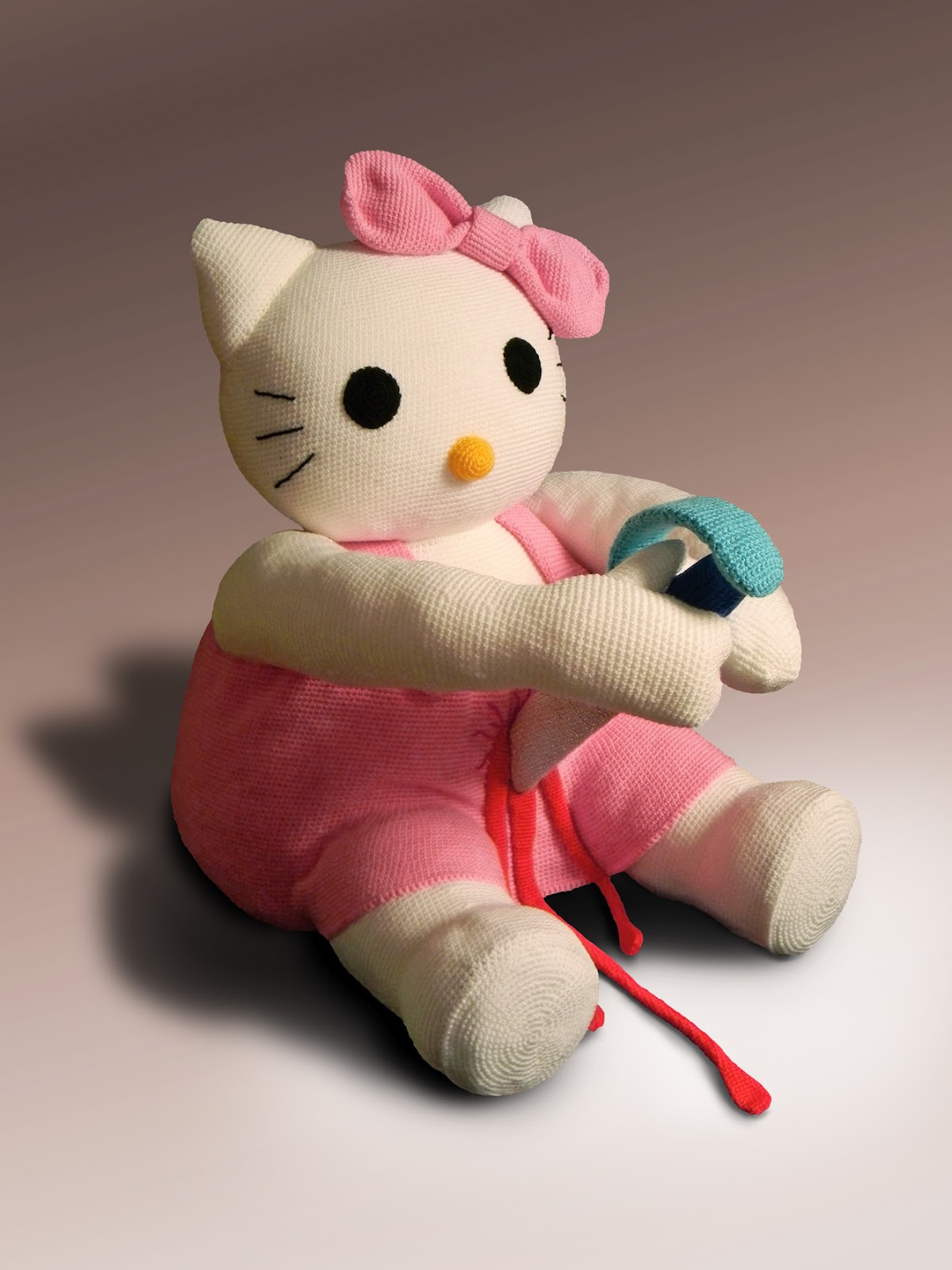 |
| "Hello Kitty," 2011. Wool, styrofoam, plastics, crochet work, 65cm x 45cm x 60cm |
 |
| "Spiderman," 2011. Wool, cotton filling, fabrics, crochet work. 90cm x 150cm x 200cm All photos courtesy of Galerie Deschler. |
The show's up through June 9, 2012.
Tuesday, March 13, 2012
Cool Splotch
By now, a year after publication, I am just plain cleaned out of ASTOUNDING KNITS. On the shelf in my office that's lined with extra author's copies to pass on to friends and colleagues, you'll spy not one bright pink-and-turqoise spine. And the reason is: my daughter's eight-year-old thug friends swiped them all. Okay, I sanctioned the swipage. And gladly, too. It's rare that the worlds of kids and books-intended-for-adults actually meet and merge. For whatever reason, AS wholly captivated a bunch of third graders.
One of their collective favorite entries was of Isabel Berglund's City of Stitches. A life-size knitted white tree held "viewers" in knitted sweater pockets inside its trunk, underneath a cloud of green knitted foliage. This past February, Berglund showed (at Specta gallery, in Copenhagen) a similarly compelling and befuddling knitted collage piece titled Floating Pearls:
"We are witnessing an object in the state of transition," says the gallery literature. Say two eight year olds hovering around my ear as I type this: "Whoa, it's a cocoon, a necklace and a splotch!" and "It's just cool!"
One of their collective favorite entries was of Isabel Berglund's City of Stitches. A life-size knitted white tree held "viewers" in knitted sweater pockets inside its trunk, underneath a cloud of green knitted foliage. This past February, Berglund showed (at Specta gallery, in Copenhagen) a similarly compelling and befuddling knitted collage piece titled Floating Pearls:
 |
| Isabel Berglund's Floating Pearls (right), shown here with Borderland (left) by Signe Jaïs |
"We are witnessing an object in the state of transition," says the gallery literature. Say two eight year olds hovering around my ear as I type this: "Whoa, it's a cocoon, a necklace and a splotch!" and "It's just cool!"
Tuesday, January 31, 2012
Saws Away!
You remember her from Astounding Knits as the Dutch sculptor who meticulously recreated bathroom fixtures in pink knitted wool. Several months ago, Desiree de Baar turned her attention to pink knitted chain saws, which she proceeded to hang in Sleenerzand Forest in Drenthe.
The knitting "worked a bit as a jacket," says de Baar, covering the hard, inner bodies of the Husqvarnas themselves since, "I needed them to be weather-proof."The project was an initiative by natuurkunst Drenthe. They collaborated with the forest and assisted in the woods. "Although the hanging (of steel cables, up to 10 meters high!) I did myself. It was really [a show about] sharpening your sights through the forest, finding those trees and the view lines with the perspective of saws."


The knitting "worked a bit as a jacket," says de Baar, covering the hard, inner bodies of the Husqvarnas themselves since, "I needed them to be weather-proof."The project was an initiative by natuurkunst Drenthe. They collaborated with the forest and assisted in the woods. "Although the hanging (of steel cables, up to 10 meters high!) I did myself. It was really [a show about] sharpening your sights through the forest, finding those trees and the view lines with the perspective of saws."


Monday, January 23, 2012
Astounding Felieke
Somewhere, somehow, I stumbled upon the work of Dutch jewelry sculptor Felieke van der Leest. I was working on KNITTING AROUND THE WORLD at the time, and decided to add her to the chapter on knitting in the Netherlands. Much to my chagrin, she was eventually cut by the editors in the final stages of manuscript prep, just as ASTOUNDING KNITS was going to press - and so too late to add her to that book, where she really belonged.
In an attempt to make it up to her, I wrote about her work for the winter issue of Twist Collective. And I'm writing about her here and now, in the hopes of spreading word of her incredible, whimsical creations among the general American populace. Some of the pieces shown here (an assortment of her newest work) contain knitted or crocheted components; some of them don't. For a wider assortment, visit Felieke at her website.
In an attempt to make it up to her, I wrote about her work for the winter issue of Twist Collective. And I'm writing about her here and now, in the hopes of spreading word of her incredible, whimsical creations among the general American populace. Some of the pieces shown here (an assortment of her newest work) contain knitted or crocheted components; some of them don't. For a wider assortment, visit Felieke at her website.
 |
| Beaver Family from Pencil Creek |
 |
| Billy the Kids |
 |
| Incognitos Anonymous |
 |
| Gonzalez Brothers |
 |
| Peace Puffin |
 |
| The End |
Tuesday, January 17, 2012
Heaven + Birds
The Sundogs have been at it again - in December, with Cloudishness, another commission from Inverness Old Town Art in Scotland. This time, rather than bombing a graveyard, the ladies (known to us as Jennifer Cantwell and Annie Marrs) used a car park elevator as their yarn-y platform.

As Cantwell explains it, "The idea was that the elevator was a portal to heaven, heaven is handmade. The ground floor was the departure lounge and there were departure lounge information messages broadcast from a cloud. We made utopian public information messages relevant to those entering Nirvana: weather reports, public safety info, travel news, directions, etc. – positive affirmations for those entering the next dimension and reassurances for anxious travellers. People loved it, it made them laugh, the elevator was working the whole time so they went to whatever floor their car was on. The sky was knitted on the machine, the clouds were made from wadding, the signs were knitted (steeking, spray glue + hot glue!)."
Cantwell also mounted a show sans-Sundogs, entitled Birdsong, using as inspiration an earlier collection of cassette tape doilies she'd made. She says of this project, which was also exhibited in Inverness:


As Cantwell explains it, "The idea was that the elevator was a portal to heaven, heaven is handmade. The ground floor was the departure lounge and there were departure lounge information messages broadcast from a cloud. We made utopian public information messages relevant to those entering Nirvana: weather reports, public safety info, travel news, directions, etc. – positive affirmations for those entering the next dimension and reassurances for anxious travellers. People loved it, it made them laugh, the elevator was working the whole time so they went to whatever floor their car was on. The sky was knitted on the machine, the clouds were made from wadding, the signs were knitted (steeking, spray glue + hot glue!)."
 |
| For those of you who remember the Sundog's previous grievances with their last, elderly knitting machine, Cantwell is pleased to report: "I've a new knitting machine now. I think my concentrated rage killed that last one." |

"I wanted to crochet sound, make patterns from the actual notes or structure of the notes. I've an interest in invisible data, coding, radiowaves, information that's all around us and in the air we breathe but [that we] can't see. Crochet turned into knitting.
"The Fair Isle patterns were knitted on a knitting machine, and the designs for the Fair Isle were taken from the shapes contained within the soundwaves of actual recordings from locations – my partner Dave is a sound designer so we recorded birds and ambient sound from different areas of Scotland and then put them through sound processing software on the computer so I was able to actually see the soundwaves and the shapes the sounds were making. Then I designed patterns from the shapes. The birdboxes are handmade, the knitting is steeked, spray glued and sewn onto them. There's an mp3 player inside each one and headphones so you can hear the soundtrack of each box. The QR codes are linked to googlemaps; each box was geotagged so if you scan the code on your phone, googlemaps will take you to the location of each recording.
 |
| All photos courtesy of Jennifer Cantwell |
"Kids loved the show and it was well received with the grown ups too. In the gallery, this film was projected on one of the walls, and I set up a knitting zone and left out needles and wool and instructions. At the opening, Dave brought his decks and dj-ed a live soundpiece made from birdsongs and knitting noises. It was brilliant."
Wednesday, January 11, 2012
Bats!
I know, I know, I've been remiss in posting about all those ASTOUNDING KNITS out there in the knitiverse. I promise to do better in 2012. And to start the year off right, here's Emily Stoneking's latest dissection, of a bat. You can knit it, too – see here. Stoneking used Frog Tree alpaca sport to stitch up the body, and Jawoll fingering weight for the wings. She needle felted the insides out of bits of wool roving then sewed them into place.

I've always been something of a bat fan. For starters, as the mosquito magnet in my house, I love the fact that certain species of bat, such as the Cave Myotis, can eat up to 3,000 mosquitoes a night. I love that the Thai bumblebee bat is the smallest mammal in the world - weighing less than a penny and measuring about 1.1 inches long. I love that bats pollinate cashews and certain cacti; sleep not only in caves but also in furled banana leaves and large tropical spider webs; and that vampire bats can run on land in addition to flying. And I love Stoneking's woolly exploration of their insides. (PS, did you know that bats and humans share a common ancestor?)

I've always been something of a bat fan. For starters, as the mosquito magnet in my house, I love the fact that certain species of bat, such as the Cave Myotis, can eat up to 3,000 mosquitoes a night. I love that the Thai bumblebee bat is the smallest mammal in the world - weighing less than a penny and measuring about 1.1 inches long. I love that bats pollinate cashews and certain cacti; sleep not only in caves but also in furled banana leaves and large tropical spider webs; and that vampire bats can run on land in addition to flying. And I love Stoneking's woolly exploration of their insides. (PS, did you know that bats and humans share a common ancestor?)
Monday, December 5, 2011
Astounding News from Andy Holden
Astounding Knits! fans will remember Andy Holden as the sculptor who recreated a nugget of Egyptian pyramid in fantastical scale. Taking his extreme pebble knitting to the next level, Holden is currently displaying a piece called the "Cookham Erratics" at the Benaki Museum in Athens, Greece. Here's how he describes it:


The six knitted sculptures each have wireless speakers in them, each transmitting a different monologue, part of a long fragmented story which attempts to explain how the rocks ended up in the museum. The idea of an 'erratic' is a rock deposited by a glacier as it melts, which often results in rocks that seem incongruous in the landscape. The other part of the story involves a tale about the British Painter, Stanley Spencer, and his image of the Resurrection at Cookham Churchyard.
Maybe you're lucky enough to be traveling in Egypt right now and can stop by to see the exhibit. For the rest of us, here are some photos:


Tuesday, May 31, 2011
Say YES to June!
It's corny, it's true, but June will persist in being the most popular month for weddings. One June bride, UK artist Freddie Robins, went so far as to knit her own wedding; admittedly, she was already married to her husband Ben Coode-Adams, and she had a great deal of stitching help from the Cast Off Knitting Club for Boys & Girls, and London's Pumphose Gallery, where the so-called "Ceremony" was staged. But that hardly makes the undertaking less impressive. Below, a few of the "wedding" snaps that didn't make it in to Astounding Knits!
Of course, any wedding requires two soft hearts. If you are Iris Eichenberg, better than 2 are 120 diminutive (4-inch) specimens, each meant to represent a friend or family member of the Dutch artist.
Finally, every wedding begins at least on some level with family members. To celebrate the genetic ties inherent in this most superlative of June ceremonies, the photo below illustrates the philosophy of Reknit, a small, quietly brilliant company comprised of graphic designer Haik Avanian and his mom, Gayane Avanian, in which participants mail in an old piece of knitting to be reknit by Gayane into something newly useful.
 |
| Coode-Adams in knitted top hat and scarf; Robins in knitted wedding dress with 95-foot train |
 |
| Knitting guests in knitted dresses |
 |
| Accoutrements of an all-knitted wedding |
 |
| 30 of Eichenberg's 120 free-hand knitted hearts |
Finally, every wedding begins at least on some level with family members. To celebrate the genetic ties inherent in this most superlative of June ceremonies, the photo below illustrates the philosophy of Reknit, a small, quietly brilliant company comprised of graphic designer Haik Avanian and his mom, Gayane Avanian, in which participants mail in an old piece of knitting to be reknit by Gayane into something newly useful.
 |
| The Avanian family, and a favorite reknit, traced through the decades |
Thursday, May 19, 2011
ASTOUNDING New Photos!
It's always aggravating, when compiling a book that includes photographs, to decide which ones stay and which ones go. This was certainly the case with Astounding Knits! So abundant were the pictures sent in by some contributors that a good number of favorites were tragically consigned to the surplus folder. Luckily, thanks to the miracle of modern technology, I can share them with you here.
Below are two new additions to this post, from a great favorite artist in our house among both resident and visiting kids and husbands, Mark Newport. If you've seen the book, you've already been introduced to his knitted Batman and Argyleman suits. Now I present...
I'll admit it, I'm a sucker for miniatures, which is why I've written about the work of Dutch micro-knitter Annelies de Kort on several occasions. In the book, I wanted to focus on the absolute smallest of her knitting, which meant that the strange and joyful context of her work was missing. Such as with the above collection of her knitted coats for wee dachshunds, and the small figure, below, which has been cast into a dollhouse-ian terrarium. Has she leapt from a great height of inches, or is she just sunbathing?
Visitors to Susette Newberry's blog have watched in fascination as over the years, she's stitched up all the letters of the alphabet, using her rabid interest in the history of typography as a jumping off point. It all starts with A, for artichoke (Cynara scolymus), of course; although in the book, this gorgeous specimen lost out to J is for Jacquard, Q is for Quatrefoil and T is for Turkey.
I've written almost as often about the work of Australia-based artist Helen Pynor as I have about that of de Kort (you can find my Twist Collective article here). And while the book focused exclusively on the organs that Pynor stitched up using human hair as her medium, she has knit other things as well, such as the "hair shirts" (my term - must be my Catholic upbringing) below.
Last but not least, who doesn't love a bit of crocheted phantasmagoria? Here, two examples from German sculptor Patricia Waller, whose slightly more gory work graced the pages of the book.
Below are two new additions to this post, from a great favorite artist in our house among both resident and visiting kids and husbands, Mark Newport. If you've seen the book, you've already been introduced to his knitted Batman and Argyleman suits. Now I present...
 |
| Sweaterman 6, 2010... |
 |
| ...And W man, 2009. Photos courtesy of the artist |
 |
| Alle Honde |
I'll admit it, I'm a sucker for miniatures, which is why I've written about the work of Dutch micro-knitter Annelies de Kort on several occasions. In the book, I wanted to focus on the absolute smallest of her knitting, which meant that the strange and joyful context of her work was missing. Such as with the above collection of her knitted coats for wee dachshunds, and the small figure, below, which has been cast into a dollhouse-ian terrarium. Has she leapt from a great height of inches, or is she just sunbathing?
 |
| Garden. Photos courtesy of Annelies de Kort. |
 |
| Photo (c) Susette Newberry, unionpurl.blogspot.com |
I've written almost as often about the work of Australia-based artist Helen Pynor as I have about that of de Kort (you can find my Twist Collective article here). And while the book focused exclusively on the organs that Pynor stitched up using human hair as her medium, she has knit other things as well, such as the "hair shirts" (my term - must be my Catholic upbringing) below.
 |
| Exhale, 2005 |
 |
| Pynor working with knitted hair. Photos by Danny Kildare, courtesy of the artist and Dominick Mersch Gallery, Sydney |
Last but not least, who doesn't love a bit of crocheted phantasmagoria? Here, two examples from German sculptor Patricia Waller, whose slightly more gory work graced the pages of the book.
 |
| Elephant |
 |
| Antlers. Photos (c) Patricia Waller |
Subscribe to:
Posts (Atom)